1,000 USDT in OKX flexible savings for a month earned about 2.21 USDT
On OKX's public hourly USDT rates from 2026-08-23 to 09-22, 744 hours in all, 1,000 USDT left in flexible savings for 31 days earned about 2.21 USDT, roughly 2.60% annualized. That is below the average borrowing rate of 3.48% for two reasons. The interest borrowers pay is spread across all eligible funds (the shared annualized rate on OKX's help page, called the shared APR below), so the lending rate averaged only 3.06%, and the platform keeps 15% of each hour's interest.
Borrowing and lending rates over the 31 days
Data range: hourly USDT rates from OKX's public API, 2026-08-23 00:00 to 09-22 23:00 (UTC).
| Measure | Borrowing rate | Lending rate | 1,000 USDT over 31 days |
|---|---|---|---|
| 744-hour average | 3.48% | 3.06% | about 2.21 USDT |
| Lowest in the 31 days | 3.00% | 2.70% | — |
| Highest in the 31 days | 5.90% | 5.66% | — |
The amount in the last column comes from taking each hour's lending rate times 85%, accruing hourly and compounding on the hour; the formula is in the final section. The lowest and highest rows are each column's own extremes and don't necessarily fall in the same hour.
Both columns come from a public endpoint in the OKX API v5 docs (Public borrow history) that needs no login: GET /api/v5/finance/savings/lending-rate-history?ccy=USDT. Each record carries a timestamp and two annualized rates: rate, labelled Annual borrowing interest rate in the docs and called the borrowing rate below, and lendingRate, labelled Annual lending interest rate and called the lending rate below. There is one record per hour, and the docs say the history goes back to 2021-12-14. Flexible is one of several OKX Earn products, alongside fixed and on-chain Earn; the number that matters here is what flexible USDT finally credits to the account.
Hour by hour, the lending rate never caught up with the borrowing rate. Over the 744 hours it averaged 0.878 times the borrowing rate; the lowest hourly ratio was 0.806 and the highest 0.960. On the averages the gap is 0.42 percentage points (3.48 − 3.06). OKX's rule of splitting interest proportionally across flexible funds explains where that gap comes from.
By day, the daily average lending rate sat between 2.8% and 3.1% on 23 of the 31 days. A few days picked out:
| Date (UTC) | Daily average lending rate | That day |
|---|---|---|
| 08-23 | 3.790% | Ranged from 2.74% to 5.46% within the day; highest daily average of the 31 days |
| 08-25 | 2.795% | Lowest daily average of the 31 days |
| 08-28 | 3.237% | Four straight days, 08-28 to 08-31, with a daily average above 3.17% |
| 09-17 | 2.859% | All eight days from 09-10 to 09-17 averaged below 2.95% |
| 09-21 | 3.348% | Ranged from 3.08% to 5.66% within the day; 5.66% is the peak of the whole period |
| 09-22 | 3.497% | Second-highest daily average, after 08-23 |
08-23 and 09-21 had the widest intraday swings of the 31 days, each with hours in which the lending rate went above 5%. On most other days the rate moved less than 0.3 percentage points within the day.
Converting to coins shows how much a spike is worth on 1,000 USDT. With a year taken as 365 days, or 8,760 hours, one hour's interest = principal × lending rate × 85% ÷ 8,760.
- The 5.66% hour: 1,000 × 5.66% × 85% ÷ 8,760 ≈ 0.0055 USDT
- An ordinary hour at around 3%: 1,000 × 3% × 85% ÷ 8,760 ≈ 0.0029 USDT
The spike hour adds about 0.0026 USDT. Watching the rate table and waiting for a peak before subscribing gains next to nothing. Under OKX's accrual rule the balance isn't recorded until the next full hour anyway, so a subscription made on seeing a spike starts counting from the following hour at the earliest and misses the spike itself.
How the shared APR works: borrowers' interest is split across all eligible funds
Under the shared APR, the interest borrowers pay is divided proportionally among all eligible lending funds, so the annualized rate on each share can't exceed what borrowers pay. The arrangement first appeared in an OKX help-center announcement published on 13 November 2025 about updated APR rules for stablecoins in flexible simple lending. From 17:00 (UTC+8) that day, USDT and USDC in flexible Simple Earn and in the auto-earn feature were lent under it. At that stage the lowest rate you were willing to lend at (the minimum lending APR entered when subscribing) was still compared with the market borrowing rate to decide whether your money qualified for a share. OKX changed the rule again from 27 August 2026, in an update to its flexible Simple Earn products: the subscription form no longer has a minimum lending APR field, borrowers' interest is split proportionally across all eligible subscriptions in that coin, and funds that had earned nothing because the minimum was set too high are included as well. Existing subscriptions moved to the new method automatically, with nothing to do.
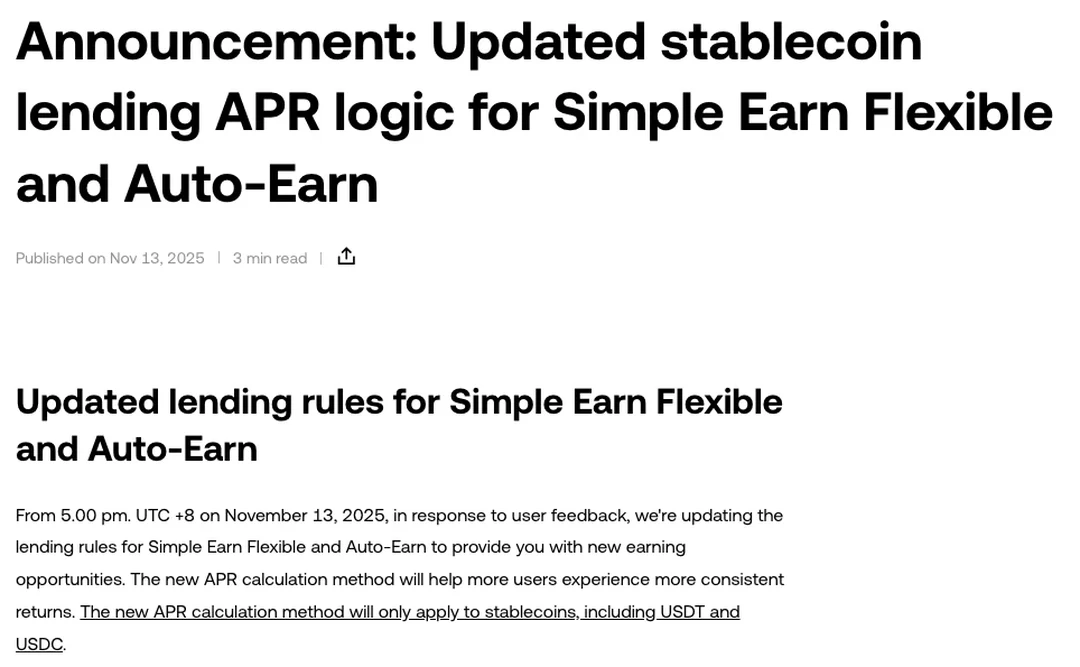
The two tests in the November 2025 version (no longer in force after 27 August; the first four days of this period, 08-23 to 08-26, still fell under it):
- Minimum lending APR ≤ market borrowing rate: the funds are eligible for lending. Interest paid by borrowers is shared equally among all eligible funds, and the actual APR is capped at the borrowing rate.
- Minimum lending APR > market borrowing rate: the funds are not lent and earn no interest.
OKX's own example: the minimum lending APR is set at 5% and the market borrowing rate is also 5%. Borrowers take 1,000 USDT in total and pay 1,000 × 5% = 50 USDT in interest over a year. Lendable funds total 1,250 USDT, so the 50 USDT spread across them gives each share an actual APR of 50 ÷ 1,250 = 4%. The announcement adds a note of its own: when the borrowing pool is smaller than the lendable pool, the final APR may be lower than the minimum lending APR you set.
Read against that rule, a lending rate averaging 0.878 times the borrowing rate in the opening table is what you would expect. More USDT was available to lend than was borrowed, the interest was spread thinner, and the rate on the lending side came out below the price borrowers paid.
The 27 August announcement no longer contains the line capping the APR at the borrowing rate, but the source of the interest and the way it is divided haven't changed. It is still what borrowers pay, split proportionally across eligible subscriptions, and with more lendable than borrowed each share ends up below the borrowers' price. The new announcement also cautions that with the minimum removed, more money enters the eligible pool and the APR could go up or down.
The platform's 15% comes out of interest, settled every hour
The 15% is taken from the interest, deducted at each hourly settlement, and the remaining 85% is added to principal on the spot. OKX's help-center FAQ for Simple Earn, updated 27 August 2026, says the platform distributes 85% of interest earnings to users and charges a 15% fee, and that once funds are lent, earnings settle hourly and are compounded automatically on the hour.
The same FAQ gives the timing. Funds lent during one hour are paid their earnings in the next. In OKX's example, a subscription at 7:30 UTC has its balance recorded at 8:00, and the earnings for 8:00 to 9:00 are paid at around 9:00. On that example the half hour from 7:30 to 8:00 earns nothing. If part of the balance is redeemed between 8:00 and 9:00, that hour is calculated on the smaller of the 8:00 snapshot balance and the balance left after redemption.
In numbers, the 15% weighs in like this: an average lending rate of 3.06% times 85% is about 2.60%. 1,000 USDT over 31 days would earn about 2.60 USDT with no fee and about 2.21 USDT after it, with about 0.39 USDT going to the platform. To check against your account, the earn card on the assets page shows yesterday's earnings and total earnings.
The rate arithmetic leaves a different question open: whether USDT flexible savings is safe, and what happens to the money if the platform runs into trouble.
Is the API's lending rate before or after the fee?
The official docs don't say. Checked against two official rules, the cap under shared APR and the 15% fee, the 744 hours of data only fit if the API's lending rate is read as a pre-fee figure, and that is how it is used here. The reasoning in three steps:
- The shared APR announcement states that the actual APR on lent funds can't exceed the borrowing rate. The 27 August announcement dropped that sentence, but borrowers' interest is still divided proportionally among eligible subscriptions, so the cap still holds.
- The Simple Earn FAQ gives 85% of the interest to users and 15% to the platform. Put together, a user's after-fee rate can be at most the borrowing rate × 0.85.
- In 552 of the 744 hours, the lending rate was higher than that hour's borrowing rate × 0.85. If the API figure were after the fee, all 552 hours would break the cap and contradict the rules. Reading it as a pre-fee figure is the more consistent interpretation.
Those 552 hours are about three quarters of the period (552 ÷ 744 ≈ 74%), and the average ratio of 0.878 is also above 0.85. In the other 192 hours the lending rate didn't exceed the borrowing rate × 0.85; either reading fits those hours, so they settle nothing.
The inference rests on assumptions: that the API's two columns are the borrowing-side and lending-side rates for USDT in flexible Simple Earn, and that both rules, proportional sharing of interest and the 15% fee, were in force throughout the 31 days (the old November 2025 version for the first four days, the new one from 27 August). The savings in the endpoint path and the words borrowing and lending in the field descriptions point to this product, and the shared APR start date of 13 November 2025 precedes the data, but the docs don't spell out how the two columns map onto the two rules.
If the API's lending rate were in fact already net of the fee, 1,000 USDT would have earned 2.60 USDT over these 31 days. The 2.21 used here is the lower of the two readings.
1,000 USDT for 31 days: inputs, formula and comparison
Inputs:
- Principal: 1,000 USDT, with no additions or redemptions during the period.
- Duration: 2026-08-23 00:00 to 09-22 23:00 (UTC), 744 full hours or 31 days, all of them hours that have already elapsed.
- Rate for each hour: the
lendingRate(lending rate) for the same hour from the API, treated as pre-fee. - Fee: 15% of each hour's interest.
- Conversion: a year is 365 days, or 8,760 hours.
Formula: balance at the end of hour h = balance from the previous hour × (1 + lending rate in hour h × 85% ÷ 8,760). Interest is added to principal at each hourly settlement and the next hour accrues on the new balance, multiplied through 744 times.
Result: a balance of 1,002.2091 USDT, or about 2.21 USDT in interest. Annualized: 2.21 ÷ 1,000 × 365 ÷ 31 ≈ 2.60%.
A rough estimate from the averages lands in the same place: 1,000 × 3.06% × 85% × 744 ÷ 8,760 ≈ 2.21 USDT. Over 31 days compounding adds only a sliver; how long it takes before auto-compound makes a noticeable difference is a separate calculation.
The same money under three methods:
| Method | Rate used | 31-day earnings | Annualized |
|---|---|---|---|
| Lending rate × 85%, compounded hourly (used here) | Lending rate, average 3.06% | about 2.21 USDT | about 2.60% |
| Lending rate with no fee, compounded hourly | Lending rate, average 3.06% | about 2.60 USDT | about 3.06% |
| Borrowing rate, simple interest | Borrowing rate, average 3.4833% | about 2.96 USDT | about 3.48% |
The third row: 1,000 × 3.4833% × 31 ÷ 365 ≈ 2.96 USDT. The drop from 2.96 to 2.21, about 0.75 USDT, comes in two parts: about 0.36 from the dilution under shared APR (2.96 → 2.60) and about 0.39 from the platform fee (2.60 → 2.21). The third row is simple interest and the first two are compounded, so the bases differ slightly, but over 31 days compounding only touches the last decimals.
The 2.60 USDT in the second row and the roughly 2.60% in the first share their digits by coincidence. One is coins earned in 31 days, the other the after-fee annualized rate. It happens because 1,000 USDT over 31 days yields about 0.85 USDT per percentage point of annual rate (1,000 × 1% × 31 ÷ 365 ≈ 0.849), which lines up with the 85%.
At the level of these 31 days, 1,000 USDT in OKX flexible savings brings in a little over two USDT a month. Of the three rates, the borrowing rate paid by borrowers is the highest, the API's lending rate comes next, and the rate that finally reaches the account is the lowest; the dilution under shared APR and the platform's 15% sit in between.
Quoting the borrowing rate as the return on flexible USDT overstates it by exactly those two steps. The yearly version of the question is how much USDT Earn can make in a year.
Risk note
The rates used here come from public records for 23 August to 22 September 2026. The borrowing and lending rates will differ in every hour after that, and 2.21 USDT and roughly 2.60% describe only the 31 days already past. Both the shared APR rule and the 15% fee are set by OKX and can change; the rule was revised as recently as 27 August. Flexible funds can normally be redeemed at any time, but OKX itself says that in the rare case where a coin's pool is fully lent out, redemption may be temporarily limited or suspended. This piece is educational reference and is not investment advice.
FAQ
When is interest on OKX flexible savings paid?
Once every hour, on the hour. Per OKX's Simple Earn FAQ, funds lent during one hour are paid their earnings in the next; the earnings for 8:00 to 9:00, for instance, arrive at around 9:00 and are then added to principal automatically to keep earning. The amounts received are shown as yesterday's earnings and total earnings on the earn card of the assets page.
Do I still need to set a minimum lending APR?
No. From 27 August 2026 OKX removed the minimum lending APR field from flexible subscriptions, and borrowers' interest is split proportionally across all eligible subscriptions in that coin. Settings made earlier lapsed automatically, and money that had been earning nothing because the minimum was set too high began earning from that day with no action needed. Subscribing now happens in the app's Simple Earn section: pick the coin and the flexible product, enter an amount and confirm. The APR is whatever the flexible page shows at the time.
Will I have to wait to redeem?
Normally not. Flexible funds can be subscribed and redeemed at any time, and the money is returned in real time. The exception OKX states is when a coin's pool is fully lent out: redemption may then face a temporary limit or suspension, which the platform reviews every hour.
Where can I look up historical OKX USDT rates?
The OKX API v5 docs include a public endpoint called Public borrow history. It needs no login and returns, per coin, the hourly borrowing rate (rate) and lending rate (lendingRate), going back as far as 2021-12-14. The docs don't state whether the lending rate is already net of the 15% fee; working back from the cap under shared APR, it is treated here as a pre-fee figure.